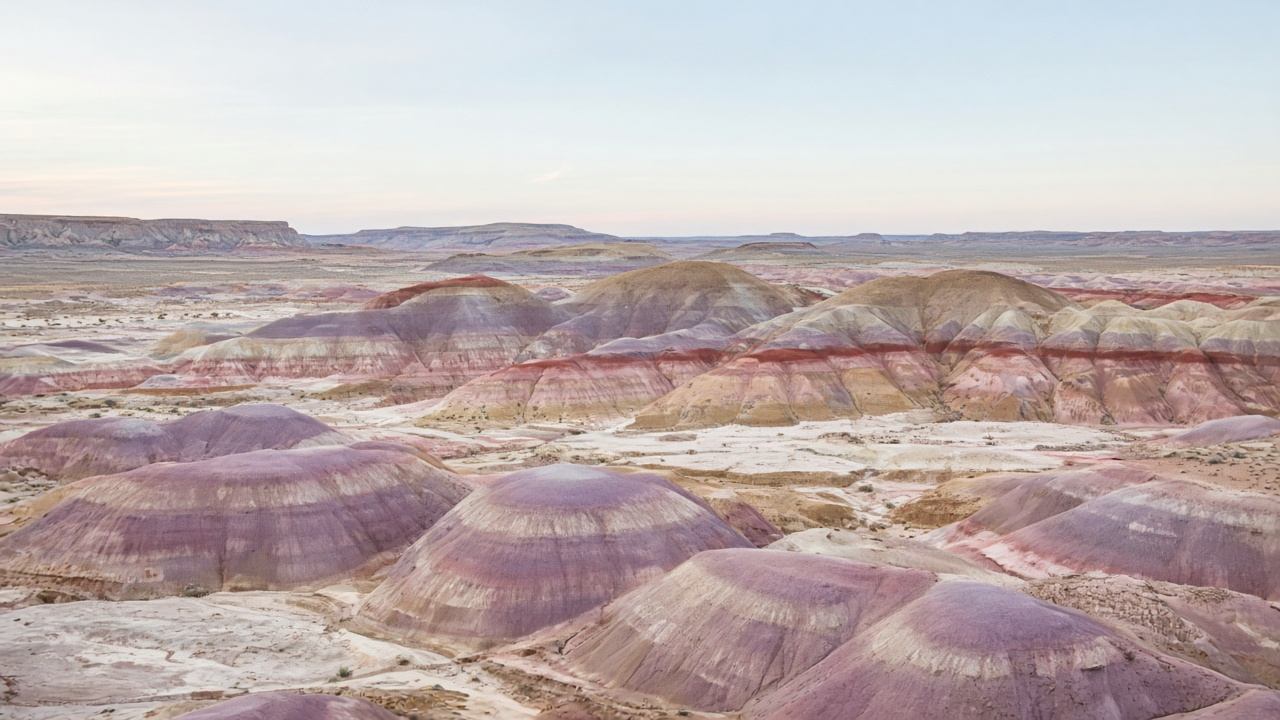
Soft Geometry, Not Sheer Walls
The Painted Badlands reward a different expectation than Arizona’s famous canyon country. Here the drama is horizontal. Iron oxides, manganese, and altered volcanic ash create bands that shift from lilac to blush to pale chalk. After rain, clay darkens and the hills look freshly brushed. In dry heat, the same slopes bleach toward lemon sand and blue shale.
Overlooks inside Petrified Forest National Park are the cleanest way to read that layering. Stay on designated platforms and short paths—fragile crust and sparse desert plants recover slowly. Pair a morning stop on the northern rim with a later walk at Blue Mesa, where the palette cools into mineral turquoise and gray-lavender.
thistleford treats the badlands as a teaching landscape. Note the direction of light, the width of bands, and how dry washes cut pale lines through darker clay. Those observations connect directly to the mechanisms explained in Desert Geology and the vocabulary collected in the Glossary.
“The hills do not shout. They arrange color until silence feels intentional.”
How to Visit Without Flattening the Story
Arrive near park opening when temperatures are still comfortable in °F and shadows define every ridge. Bring water, sun protection, and offline maps. Use Holbrook as a base town, then sequence overlooks with the three-day itinerary rather than racing every pullout in one afternoon.
If you continue south, the badlands hand off to fossil forests and plateau roads covered in Petrified Forest and Scenic Routes. Keep Route 66 as a quiet historical accent—see Route 66 Arizona—not as neon theater that overpowers the geology.